The Five-Minute Walk That Gives a City Errand a Second Purpose
A five-minute walk can add gentle movement to a city errand. Compare route, timing and destination options to choose a segment you can repeat.

The common mistake with a five-minute walk is treating it as an extra trip that must be fitted around everything else. That can make a simple opportunity feel like another appointment. A five-minute walk works better when it is attached to a city errand already on your calendar: the walk becomes part of getting somewhere, not a separate task.
The useful choice is where to place that walking segment. You might take a slightly longer route, get off transit earlier, or leave a small buffer at the destination. Each option gives the errand a second purpose, but each suits a different schedule, street layout and comfort level. Choose the one that adds movement without making the practical task harder.
Choose a route that adds distance without adding decisions
A direct route is often easiest to repeat because you already know where you are going. To add a short walk, select one clear detour: a parallel street, a passage through a public square, or a block that takes you past a familiar landmark. The point is not to find the most scenic route. It is to make the added segment easy to recognise and follow.
This approach suits errands with a flexible arrival time, such as picking up a library hold or visiting a local shop. It is less suitable when you are carrying something awkward, rushing to an appointment, or walking through an area that feels uncomfortable at that time of day. In those cases, keep the direct route and choose another option.
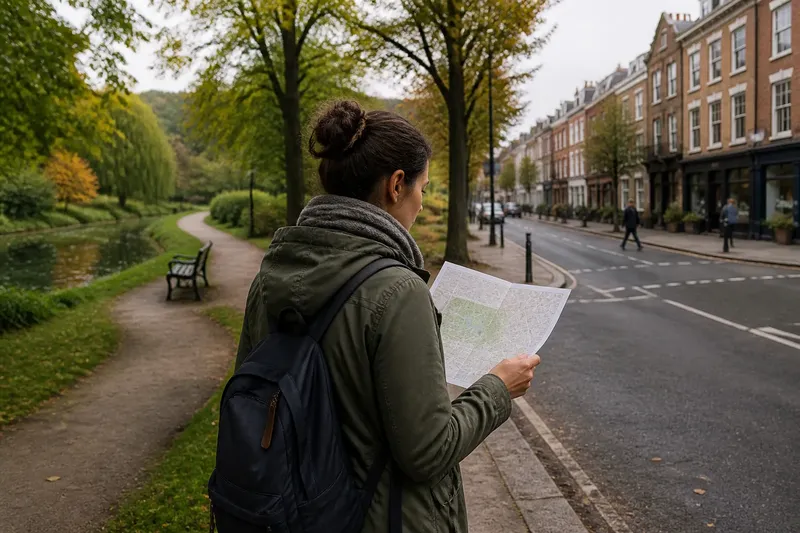
Keep the detour simple. A turn at a recognisable corner is easier to remember than a route that depends on checking a map repeatedly. If you use Google Maps or Apple Maps, save the destination and glance at the route before leaving rather than looking down while crossing streets. A paper note or a familiar landmark can work just as well.
Say you are going to collect a parcel from a shop on your usual route home. You choose a parallel street with a clear crossing and rejoin your normal route at the shop entrance. The errand still ends at the same place, while the added segment gives you an unhurried stretch of walking. If the street is busy or blocked, take the direct route instead; the errand does not need to become a test of persistence.
Use an earlier stop when transit already carries most of the trip
Getting off a bus, tram or train one stop earlier can create a straightforward walking segment. This option suits a route with dependable service and a comfortable pedestrian connection between the earlier stop and the errand. It can be especially convenient when your usual journey already passes close to the destination.
Before making this your regular choice, check the whole connection. Look for a continuous pavement, safe crossings, useful lighting for the time you travel and a route that does not require a complicated transfer. A map can show distance, but it cannot tell you how a crossing feels at rush hour or whether a pavement is obstructed. A familiar local route is often a better choice than a shorter line on screen.
An earlier stop is not automatically the easiest option. Service changes, weather, mobility needs or bags may make it awkward on a particular day. Keep your usual stop as the fallback. If the walk is comfortable, it can become part of the journey; if not, take the closer stop and complete the errand as planned.
Arrive early and walk near the destination
A small time buffer can be the simplest approach when you cannot alter your route or transit stop. Leave home as usual, then use a nearby public space or a quiet block before entering the shop, office or community building. This works well for errands with a predictable opening time or a wait before a collection is ready.
The main advantage is control. You decide how much of the buffer to spend walking, and you can stop when it is time to go in. Choose a place where you can keep track of the entrance and avoid walking so far that you risk being late. A courtyard, a broad pavement along a familiar street, or a publicly accessible square may be more practical than a complicated loop.
This option is less useful when the errand involves a strict appointment or when nearby streets are crowded. It can also feel like waiting in motion rather than part of the journey. If that bothers you, choose a route-based segment instead. The best arrangement is the one that feels like a natural part of the errand, not an obligation attached to it.
Match the walking option to the errand
Compare the three approaches by asking what your trip already allows. A route detour is useful when you can change streets but need to arrive at the same time. An earlier transit stop suits a journey with a safe, simple connection. A destination buffer works when timing is flexible but the route itself is fixed.
Use these questions to make the choice specific:
- Is the arrival time flexible? If yes, a short buffer may fit. If not, favour a route or transit choice that does not add uncertainty.
- Will you be carrying anything? A light bag may be fine on a detour; bulky shopping may make the direct route more sensible.
- Is the walking environment comfortable at the time you travel? Consider crossings, pavement access, lighting and how busy the area feels.
- Can you remember the added segment without repeated phone checks? A simple landmark or one-turn detour is easier to repeat.
- Does the option still work if the day changes? Keep a direct route or usual transit stop available as a practical alternative.
Where access, opening arrangements or transit conditions depend on local rules or the provider, check the relevant information before making the route a regular part of your trip.
Which five-minute walk fits your routine?
Should I choose the same route every time?
A familiar route reduces the number of decisions involved, so it can be easier to remember. You can still use a direct route on days when the usual segment is crowded, uncomfortable or inconvenient.
Is getting off transit early better than taking a detour?
It depends on the journey. An earlier stop can be simple when the connection is clear, while a detour may suit a trip where transit timing or the walk from another stop is awkward.
What if I have only a few minutes before the errand?
Choose a short, visible segment close to the destination, or keep the trip direct. A fixed errand should remain practical; the walking opportunity is optional.
How can I tell whether the segment is easy to repeat?
Notice whether you can describe it plainly, such as “turn at the bakery and rejoin the main street”. If it requires several map checks or makes you anxious about timing, simplify it or try another option.
Let the errand set the boundary
A repeatable walking segment has a clear beginning and end. The errand supplies both: leave from the usual starting point, walk the chosen portion, then continue to the place you need to reach. That boundary helps keep the plan low-pressure. You do not have to extend the walk once the practical task is done.
Keep the first choice modest. A short detour or an earlier stop is enough to see whether the route fits your day. If it does, repeat it when the same errand comes around; if it does not, adjust the segment rather than judging the whole idea by one awkward trip. The five-minute walk works best when it makes an existing city errand easier to inhabit, not harder to complete.