Why a Short Stretch Break Can Mark a Pause in a Long Desk Session
A short stretch break marks a pause in a long desk session. Choose a comfortable movement, fit it around shared space and return to work with a clear next task.
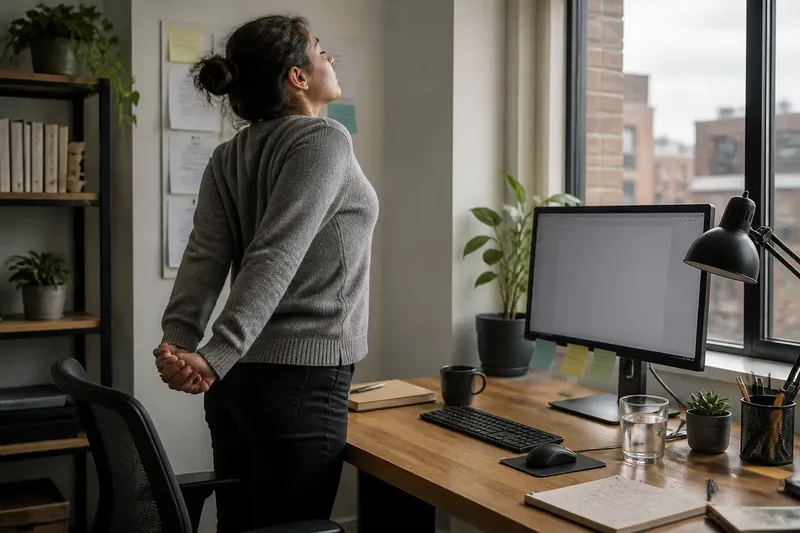
The common mistake during a long desk session is waiting until you feel stiff or fed up before changing position. By then, a short stretch break can seem like another task, so the chair wins by default. Treat it instead as a modest pause: change posture, then return to the work you had already planned.
You do not need a perfect stretch, special clothing or a clear patch of floor. In a city office, shared studio or compact home workspace, standing beside your desk, gently rolling your shoulders or walking to refill a glass can mark a break in the session.
A short stretch break is a modest change of position
Stretching can sound like holding a deep pose until you feel a strong pull. That may be awkward at a shared desk, and pushing farther is not necessary. For a desk break, try standing, reaching within an easy range, turning your head gently or letting your arms rest by your sides while you breathe normally.
Desk work often keeps your hands near the keyboard, your gaze on the screen and your feet planted. Changing one or two of those details briefly gives the session a natural pause. It does not need to produce a particular health or concentration outcome.
Keep the movement quiet and considerate. Standing to look out of a window or walking to the printer may suit a shared office better than stretching in an aisle.
Attach the break to a cue you already notice
“I’ll stretch when I have a moment” does not identify a moment. Work can keep offering one more edit or message, and the break slips away.
Instead, connect it to a visible transition: after sending a finished email, before joining a video call or when one task ends. A cue tied to your actual routine may be easier to notice than a rigid timetable.
Say you are working at a kitchen table and usually remain seated while a file uploads. When the upload indicator finishes, stand, ease your shoulders back and walk to the sink for water. The observable result is a clear pause between that task and the next one; it is not a promise about how you will feel afterwards.
Choose a cue that fits your habits. If you often ignore calendar alerts, another notification may blend into the background. Moving from your desk chair to a meeting room might be a more noticeable transition.
Choose a movement that fits the shared space
A movement can take up room, attract attention or obstruct someone’s route. Adjust it to the people and space around you.
- At a crowded desk: If there is room to stand beside your chair without blocking a route, stand and gently open your hands; if not, relax your hands while seated instead.
- In a meeting room: If the room is empty and the route around the table is clear, take a short walk; if colleagues are present or space is tight, stand near your chair and shift position comfortably.
- At a home workspace: If a clear patch of floor is available, step away from the screen for a gentle reach; if not, choose a small seated movement that does not crowd nearby furniture.
- In a shared studio: If a quiet corner is free, use it for a brief stretch; if it is occupied, stay at your own workstation or take a walk along a clear corridor.
- Near a doorway: If the doorway and walkway are clear, stand nearby for a moment; if people need to pass, move to an unobstructed spot.
- Using a chair or desk: If you can stand without support, use the furniture only as a point of orientation; if you feel unsteady, remain seated and choose another comfortable position change.
Do not use another person’s desk or chair for support without asking. Keep doors and walkways clear. Standing and shifting your weight comfortably is enough if a larger movement does not fit.
Keep the movement simple and comfortable
A break that needs a sequence of poses, a timer and an empty floor may be easy to postpone. Choose one familiar movement: stand and reach upwards only as far as feels comfortable, turn your head gently from side to side, or walk to the water cooler.
Keep the range mild. Do not bounce, strain or hold your breath. If a movement hurts, stop and choose another way to change position. If pain, injury or a health condition affects what feels suitable, ask a qualified health professional for advice.
Fit the pause around the work and make the return clear
A break can feel badly timed during a difficult paragraph or complicated conversation. Look for a natural seam, such as saving a draft, ending a call or preparing to open the next task. If work cannot pause, make a smaller change: relax your hands, uncross your legs if comfortable or look away from the screen briefly.
Before standing, name your next action. “When I sit down, I’ll check the last paragraph” gives the pause an endpoint and makes the return specific. A sticky note beside the monitor can prompt you at task transitions; a recurring calendar prompt may suit a predictable solo work block. If notifications become distracting, remove the alert and use a physical cue instead.
In a library or café, closing your notebook or putting away your headphones can mark a transition. If you step away, keep your belongings from occupying extra seating or a shared route.
What readers ask about a short stretch break?
How long should a short stretch break last?
There is no single duration that suits every task or workplace. Keep the pause brief enough to fit a natural seam, and return when you are ready to continue rather than chasing a fixed target.
Can I take a short stretch break without leaving my desk?
Yes. You can stand beside your chair, relax your hands or change your gaze without walking away. If space is cramped, choose a movement that does not obstruct anyone else.
What if I forget to take a short stretch break?
Link one simple movement to a transition you already notice, such as finishing a call or sending a document. If you ignore alerts, try a physical cue such as closing a notebook instead of adding more notifications.
Should a short stretch break feel uncomfortable?
No. A desk break does not need a strong sensation to count as a change of position. Stop any movement that causes pain, and ask a qualified health professional if you are unsure what is suitable for you.
Let the break mark a pause, not a promise
A short stretch break can separate one task from the next without becoming a workout or a measure of productivity. Choose a comfortable movement, fit it to the room and decide what you will do when you return. For a long desk session, that simple pattern makes the pause easier to place in your actual routine.